![TYP_Logo-09-1.png]](https://help.thankyoupayroll.co.nz/hs-fs/hubfs/TYP_Logo-09-1.png?height=40&name=TYP_Logo-09-1.png)
Updated: May 2026
When you enter leave in a timesheet you can check the value of what leave is paid at by clicking in the entry field of the timesheet. This will also show how many days or part days are deducted from the employee's leave balance for that timesheet entry. This is especially important for employees on the '8% of Gross Earnings' leave setting (such as casuals and fixed-term employees) as they do not have a set day size in the system. The system will take any amount entered for leave as indicating a full day of work and will pay an average day.
.png?width=52&height=52&name=Info%20-%20Blue%20Block%20(1).png) For a part day of leave, you have to manually change the number of days deducted - instructions shown below.
For a part day of leave, you have to manually change the number of days deducted - instructions shown below.
Follow this example of how to check your entry. We have used Sick leave for this example.
All Leave types and Public Holidays off will default to Average Daily Value.
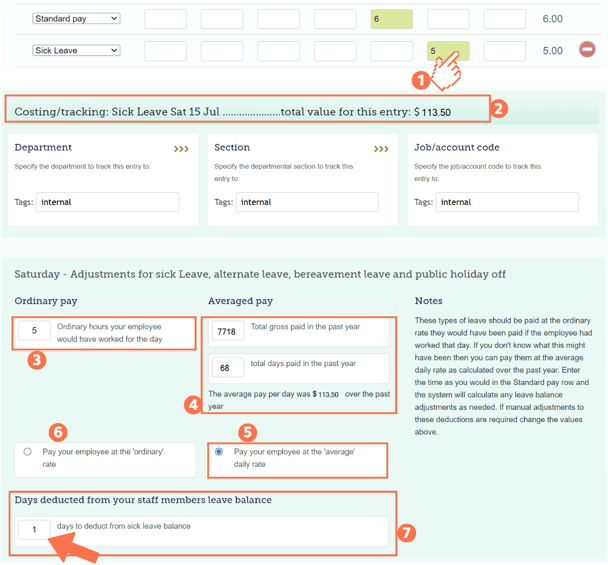
- In your saved timesheet (with green boxes), left-click in the sick leave hours entry field to access that entry's calculation data. Scroll down to find the cost tracking information below the timesheet.
- This line shows the amount to be paid for the sick leave. The system defaults to the employees average daily rate for a full day of leave regardless of the hours entered into the timesheet.
- In this example, a total of $ 113.50 will be paid regardless of the hours entered in the timesheet. being the employees average daily pay.
- This system takes the number of hours you entered into the timesheet (step 1) as the ordinary hours the employee would have worked for this particular day, as a casual employee doesn't have set hours or days.
- In this example, the 5 hours entered into the timesheet are taken as 5 ordinary hours for Saturday 15 July.
- If you wish to pay the employee their ordinary hourly rate (Step 6), and not their average daily pay (default) you need to ensure that this number is the number of hours the employee would have worked on this day.
- The numbers used for calculating the average daily rate is shown here.
- This setting is toggled on by default to pay leave at average daily pay for an employee on the '8% of Gross' leave setting.
- If you want to pay your employee their hourly rate, click the button to switch to the 'ordinary rate' setting.
- This number shows how many days or part days will be deducted from the employee's leave balance for this entry. Make sure that this number is not more than a day. It can be part of a day, e.g. 0.5 (half a day), 0.25 (quarter of a day) etc. You can manually adjust this to the correct number.
- In this example, the casual employee is taking a full day of sick leave. The system automatically takes 1 day from their leave balance regardless of the number of hours entered in the timesheet. If it was a 1/2 day it would require adjusting down to 0.50
How to adjust when taking a part day as sick leave:
There are three important places you need to manually change to ensure your casual employee is paid correctly and their sick leave balance is deducted with a part day.
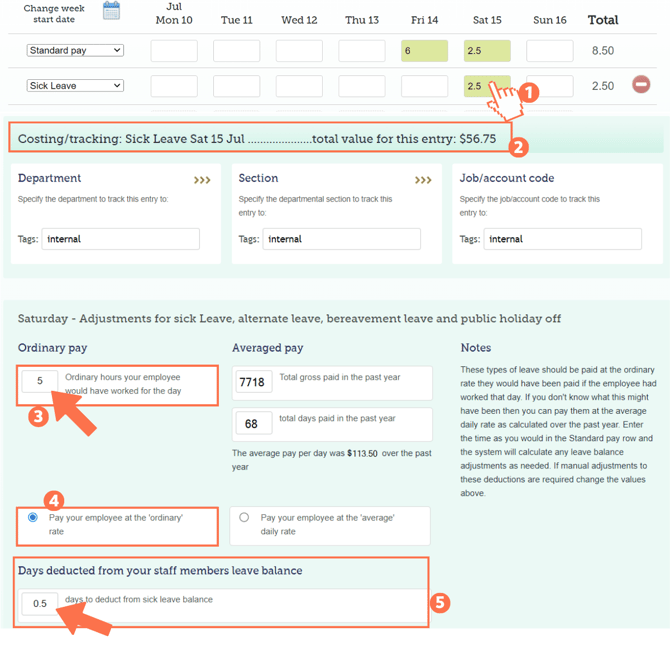
This example shows what the Costing screen will look like after all the changes have been made:
- In your saved timesheet (with green boxes), left-click in the sick leave hours entry field to access that entry's calculation data. Scroll down to find the cost tracking information below the timesheet.
- This line shows the amount to be paid for this entry. Originally this will be the amount for a full day of sick leave (i.e. $113.50 as in the example above) at the average daily rate. You will manually toggle the system to pay for the hours on the timesheet in Step 4, so this number will update. Check back on this number after following the steps in this guide.
- This example shows what the pay will be after all the changes have been made. The line shows that for the entry clicked (Sick Leave on Saturday 15 July) the total pay has dropped from $ 113.50 to $ 56.75 based on the hourly rate per hours entered in the timesheet. Meaning: this entry is worth $ 56.75 to the employee, which is based on their hourly rate.
- Check this number is the total amount of hours the employee would have worked on this day. (Standard pay hours + sick leave hours).
- This will default to the hours entered in the timesheet. Update to reflect all the hours for this day. In this example, the original entry was 2.5. It was manually changed to 5 hours.
- Toggle on this setting to pay at the ordinary rate. This will pay your employee their hourly rate based on the hours entered in the timesheet box.
- After toggling on this setting, the cost tracking pay amount will update to the new amount. (Step 1, shown as per the example)
- Change this number to the correct part of a day to be deducted from the employee's sick leave balance. It can be part of a day, e.g. 0.5 (half a day), 0.25 (quarter of a day) etc.
- Remember to Update and Save the timesheet after making these changes.
If you do not make these changes, the system will overpay the employee and deduct a full day from their sick leave balance. e.g. in this timesheet example, the system will pay the standard pay entry of 2.5 hours plus a full day's pay (ADP) for the sick leave entry ($ 56.75 + $ 113.50 = $ 170.25 for Saturday's timesheet entries) and deduct a full day of sick leave from the employee's sick leave balance.